

Fortnightly Magazine – November 2026
The U.S. power sector stands at a critical juncture, driven by unprecedented load growth from data centers, domestic manufacturing, and rapid electrification. According to the U.S. Department of Energy’s latest National Transmission Needs Study, the nation must expand transmission capacity by 60 percent by 2030 — and potentially triple it by 2050 — to keep pace.
PUF Executive Editor Rachel Bryant discussed advanced reconductoring as a solution with TS Conductor CEO Jason Huang. While legacy conductors like ACSR and ACSS suffer from thermal sag that requires expensive structural retrofits and tall replacement towers, TS Conductor’s next-generation technology allows utilities to double or triple line capacity on existing structures within months.
Advanced conductors are shifting from temporary congestion fixes to foundational, 40-year capital assets. To de-risk supply chains and support national energy security, TS Conductor is expanding with dual-coast manufacturing facilities in California and South Carolina to deliver manageably short lead times for U.S. utilities.
PUF’s Rachel Bryant: Large loads like data centers have been increasingly bringing their own power and/or co-locating with new generation. So why the focus on transmission expansion? Is it as needed as people have been saying?
Jason Huang: The surge in load demand we’re seeing requires two interrelated solutions: on the supply side, we need to build and interconnect new electricity generation; also bridging supply and demand, we need to ensure that electrons can reach the large loads such as data centers and onshore manufacturing. That comes down to having enough transmission capacity. The industry desperately needs more of it, as soon as possible.
PUF: Utilities are facing unprecedented load growth from data centers and electrification, but building new lines can take many years (including and especially permitting). How does advanced reconductoring allow utilities to double corridor capacity on existing structures in months — and how are federal initiatives like the DOE’s SPARK program helping accelerate that push?
Jason Huang: New line builds are necessary for specific areas but slow. We need to rapidly increase transmission capacity within the corridors and rights of way that we already have. Electrons move through the wires, such as conductors. Doing so with the same century-old conductor technology, such as Aluminum Conductor Steel Reinforced (ACSR) cable, is essentially a physical impossibility.
If structures are too old in existing corridors, utilities may have to consider rebuilding. While using 50-year-old Aluminum Conductor Steel Supported (ACSS) cable technology can increase transmission capacity, it sags significantly with heat, requiring taller structures and shorter span distances, with more towers and poles, and ultimately, a much higher project cost.
If structures are still viable in existing corridors, utilities may consider reconductoring, leveraging both the existing corridor and existing structure. The excessive sag with ACSS technology requires inevitable and expensive structural retrofits, such as raising the tower height, leading to longer outage times and making the cost of reconductoring relatively expensive.
Advanced conductors feature low-sag composite cores that can avoid structural retrofitting in reconductoring. Besides workability challenges, first-generation advanced conductors are expensive.

For instance, Aluminum Conductor Composite Reinforced (ACCR) cable technology features expensive ceramic fibers, multistrand composite core conductors use imported composite cores, and monolithic composite core conductors have to use overseas stranders.
TS Conductor’s Aluminum Encapsulated Carbon Core (AECC) is the next-generation advanced conductor, as it is designed with effective protection for the composite core. The next generation is all about workability and designing in safety, reliability, and longevity.

The pretensioned composite core in AECC facilitates robust bending and handling in the field, and the aluminum encapsulation eliminates galvanic corrosion and all degradations to the polymeric constituents in the composite, from moisture, air, UV, or ozone.
It also maintains full compatibility with traditional field work practice, enabling the use of the same tools, methodology, and training as traditional conductors, for safe and easy installation and maintenance. It is also cost effective to leverage AECC conductors, as they are made in the U.S. using fully vertically integrated manufacturing.
AECC also features more aluminum, for greater capacity in a compact design. In reconductoring, AECC can be deployed at large scales for 2.5x capacity increases, without structural retrofit.
With additional capacity enabled by high emissivity coating, AECC can deliver 3x capacity increases in existing corridors, without retrofitting any structures, for a fraction — approximately 1/5th — of the project cost of rebuild or about half of the project cost compared to the ACSS option, and it does so with speed as there is no extended outage due to avoided retrofitting.
Federal initiatives like the U.S. DOE’s SPARK program, Speed to Power through Accelerated Reconductoring, and other Key Advanced Transmission Technology Upgrades, are driving immediate adoption. It specifically calls out reconductoring with advanced conductors as one of the three main priorities.
SPARK provides direct federal grants to offset upfront material costs, de-risk utility capital investments, and standardize advanced tech integration. By funding high-impact reconductoring projects nationwide, SPARK helps utilities bypass multi-year planning queues and rapidly deliver gigawatt-scale capacity to critical regions.
PUF: FERC Order 1920 requires 20-year planning. Why should advanced conductors be seen as a long-term core asset rather than just a quick fix?
Jason Huang: Advanced conductors are the definition of a long-term core asset. Traditional conductors like ACSR, and ACSS to a lesser extent, are the quick fix. Sure, they’re familiar to utilities, but these legacy conductors are immediately outdated upon energization and not designed for the capacity expansion needs that today and tomorrow’s surging electricity demand require.
By contrast, next-generation advanced conductors like AECC represent a future-proof, foundational asset designed for the modern grid. They add the capacity headroom that today and tomorrow’s grids need, doubling or tripling line capacity on existing rights-of-way and significantly slashing line losses.
Furthermore, AECC delivers superior asset longevity compared to first-generation advanced conductors. While the first-generation features exposed cores that are vulnerable to bending, fracture, and environmental degradation during storage, installation, and service, AECC features a completely sealed pre-tensioned carbon core inside a protective aluminum sheath. This design ensures standard utility handling and multi-decade structural durability under extreme operating conditions.
This long-term value directly aligns with both federal and state legislative shifts. As FERC Order 1920 requires utilities to integrate advanced technologies into 20-year planning scenarios, state-level legislation in Virginia, California, and New Jersey are increasingly pushing utilities to evaluate advanced conductors in their Integrated Resource Plans.
Reconductoring with the right technology elevates advanced conductors from an immediate congestion solution to a permanent, fundamental infrastructure investment that maximizes ratepayer value for decades.
PUF: Why is U.S.-based manufacturing critical for utilities trying to de-risk supply chains and scale up reconductoring today?
Jason Huang: In the face of growing geopolitical volatility and international supply chain bottlenecks, U.S.-based domestic manufacturing offers an opportunity to fortify American energy security and energy independence.
As an American-owned company, TS Conductor is establishing robust domestic manufacturing capabilities across both the West Coast in Huntington Beach, California and East Coast in Hardeeville, South Carolina. It is providing dual-coast manufacturing redundancy and proximity to major transmission corridors, with manageable lead times of six months or less, and quality and cost under control.
This strategic footprint enables streamlined procurement for utilities and rapid deployment of advanced conductors to meet surging electricity demand.
Beyond logistics, expanding domestic manufacturing creates skilled American jobs, fosters local economic development, and drives technological leadership on American soil. Onshoring the production of homegrown technology like AECC ensures that investments in critical grid infrastructure directly support national industrial strength and energy security and independence.
In these ways, deploying domestically manufactured AECC conductors empowers utilities to modernize and expand power grid capacity with speed and confidence, all while strengthening America’s grid resilience through a secure, independent, and domestic supply chain.
PUF: When you look at capacity added per CapEx dollar spent over time to implement, why does reconductoring without structural retrofits win?
Jason Huang: We’ve all heard the phrase, time is money. And in recent months, we’ve all seen the phrase, speed to power, rather than just power. That’s because there’s an important time value to transmission capacity expansion.
It’s not about doubling transmission capacity eventually. Utilities, large loads such as data centers, and federal government priorities all highlight the immediate need for expansion. This becomes more than a pure project CapEx calculation. It’s about CapEx investment and the transmission capacity it unlocks over a near-term time window.
While advanced conductors carry a modest material premium over legacy wire, that initial conductor cost difference pales in comparison to the project-level savings achieved by utilizing existing towers and foundations, which averages 30 to 40 percent lower overall project costs.
But time savings are even more influential in today’s environment. By avoiding expensive structural reinforcements, civil engineering works, and long land acquisition processes, utilities double line capacity fast.
Traditional line builds or heavy structural overhauls hold capital for up to a decade before generating returns. Reconductoring with AECC unlocks gigawatt-scale capacity in months, dramatically improving the present value of the investment.
AECC further maximizes this economic metric through field workability and operational reliability. Because AECC utilizes standard installation tools and techniques familiar to utility line crews, installation risk is minimized, preventing costly delays, field damage, or expensive rework during deployment.
By combining reduced capital expenditure on structures with rapid execution and high field reliability, AECC delivers the highest capacity yield per dollar spent over the shortest time to implement.
PUF: How can utilities monetize line loss savings when making CapEx investments in advanced conductors?
Jason Huang: Monetizing line-loss savings requires utilities and regulators to look beyond traditional ratemaking frameworks, where line losses are treated strictly as an operational pass-through cost borne by ratepayers. Because standard cost-of-service regulation offers utilities no direct return for reducing line losses, captured efficiency must be integrated directly into utility capital planning and regulatory incentive structures.
Performance-based ratemaking and performance incentive mechanisms allow state regulators to explicitly tie utility financial returns to efficiency outcomes. Under PBR, utilities can earn direct financial rewards or shared-savings bonuses when deploying low-resistance advanced conductors like AECC that measurably reduce line losses below established baselines.
In wholesale electricity markets operated by RTOs and ISOs, line losses directly influence locational marginal pricing. By cutting line losses in half compared to legacy conductors, AECC deployment reduces the marginal cost component of energy delivery, relieving local grid congestion and driving down overall wholesale power procurement costs.
In turn, utility regulators can factor these lower peak generation and energy procurement requirements into long-term IRPs, allowing utilities to avoid over-investing in expensive peaking generation.
Finally, because AECC is installed as a capital asset, incorporating line-loss evaluations into lifecycle cost-benefit analyses allows utilities to justify the upfront investment to public utility commissions. Lower line losses reduce the total cost of ownership over a 40-year asset life, effectively translating operational efficiency into a higher rate-base return while delivering net lifetime savings to ratepayers.
PUF: How does AECC compare directly to ACSS, and why is AECC the more compelling technical choice for the industry?
Jason Huang: When evaluating high-temperature transmission conductors, the true differentiator lies in the design and material composition of the load-bearing core. While ACSS uses a traditional steel core, TS Conductor’s AECC utilizes a pre-tensioned, monolithic carbon fiber core fully encapsulated in protective aluminum and outer trapezoidal aluminum stranding.
AECC’s architecture makes it a superior technical choice over ACSS for a few reasons. One is negligible thermal sag: Steel expands significantly under thermal load. When operating at high temperatures to push peak capacity, ACSS exhibits severe thermal sag, often requiring taller replacement structures or costly tensioning to maintain safe ground clearances.
Conversely, AECC’s carbon core features an extremely low coefficient of thermal expansion. Beyond the knee point, thermal expansion drops to near zero, virtually eliminating thermal sag at high operating temperatures, from up to 200°C to 250°C.
Also, weight, strength, and span lengths: Carbon fiber provides a significantly higher strength-to-weight ratio and elastic modulus than steel. AECC is lighter than ACSS for the same current-carrying cross-section, allowing longer spans, lower tension on existing structures, and superior resistance to ice and heavy mechanical loads.
Another reason is protected monolithic design: Unlike bare steel cores in ACSS that rely on galvanized coatings vulnerable to environmental degradation over decades, AECC locks its pre-tensioned carbon core inside an airtight aluminum sheath. This complete seal shields the core from moisture, oxygen, and galvanic corrosion.
Choosing ACSS locks utilities into legacy thermal sag limitations, while AECC is the higher-capacity, highly durable option that modernizes lines on existing structures without structural compromise.
This article originally appeared in Public Utilities Fortnightly.
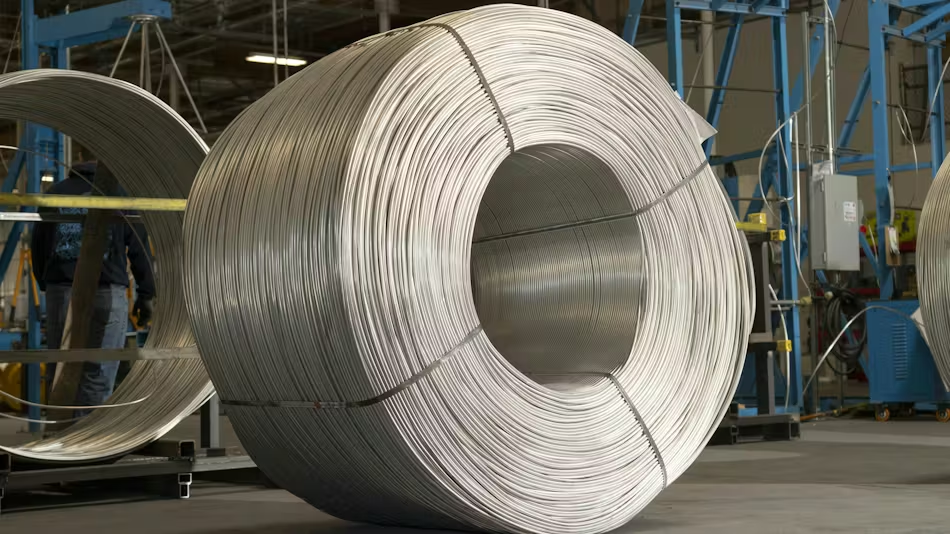
Image: Spools of raw materials prepared for AECC conductor production in TS Conductor’s Huntington Beach, CA facility.


